83% of HBCU Students Feel Connected. This Supports Student Success.
Key Takeaways
- 83% of HBCU students feel connected to their campus community, compared with 73% of college students nationally.
- Students who feel a strong sense of belonging earn better grades, stay enrolled at higher rates and experience better mental health.
- HBCU students report higher rates of flourishing mental health and lower rates of anxiety than national averages.
- HBCU graduates are more likely to thrive financially and find purpose in their careers after college.
- Mentorship, shared culture, traditions and supportive communities help HBCUs foster student success.
- Families should evaluate campus culture and support systems alongside rankings when choosing a college.
If you’re a student weighing your college options, or a parent helping your child decide, one question tops the list: Will my child belong here? At historically Black colleges and universities (HBCUs), the answer comes through loud and clear. A 2025 report found that 83% of HBCU students see themselves as part of their campus community, compared with 73% of college students nationally and 72% of Black students at predominantly white institutions (PWIs).
Belonging is not a feel-good extra. Research consistently shows that students who feel accepted, supported and connected to their campus community earn better grades, are more likely to stay enrolled and experience stronger mental health than peers who feel isolated.
For families, that is encouraging news. Success in college is not determined solely by academic ability. Feeling connected to classmates, faculty and the broader campus community can play a powerful role in helping students thrive, persist through challenges and ultimately walk across the stage at graduation.
What the 83% Number Actually Measures
Researchers surveyed more than 2,500 students across 16 HBCUs and two predominantly Black institutions (PBIs), and then compared the results with those from the national Healthy Minds Study.
Students earned that 83% by agreeing with a simple statement: “I see myself as part of the campus community.” The University of Michigan School of Public Health, which houses the Healthy Minds data, called the analysis one of the most thorough looks at HBCU student well-being to date.
The connection runs deeper than a single survey question. Sixty percent of these students said they have friends with whom they can share their thoughts and feelings. More than half pointed to a club or community where they truly fit.
Why Connection Drives Student Success
Prairie View A&M University 2012 Homecoming Parade. Photo from 2C2K Photography/Flickr.
Belonging and achievement work together. Decades of education research link a strong sense of belonging to higher persistence, better grades and healthier minds. When students feel seen, they show up, ask for help and stick around through the hard semesters.
The HBCU data backs that up. According to the same UNCF report, 45% of HBCU students reported flourishing mental health—nine points higher than the 36% national average. They also reported lower anxiety, lower substance use and less risk of developing an eating disorder than their peers nationwide.
The Payoff Doesn’t Stop With Graduation
Gallup studied tens of thousands of graduates and found that HBCU graduates are more likely to thrive afterward, especially in financial and purpose-driven well-being. The Gallup findings show 40% of HBCU graduates are thriving financially, compared with 29% of Black graduates from other institutions. Gallup also found that HBCU graduates led 51% to 43% in well-being, the measure of whether people like what they do each day.
Brookings researchers point out that HBCUs reach these outcomes while serving many students from low-income families and operating with far fewer resources than wealthier universities. The schools do remarkable work with modest budgets.
How HBCUs Build That Connection

McNair High School Marching Band on September 2019 in East Atlanta Village, Atlanta, GA. Photo by Flickr/Yours For Good Fermentables.com.
So what creates the bond? A few ingredients show up again and again.
- Shared culture and history: Students walk onto campuses built to affirm them, where faculty and classmates reflect their backgrounds and expect them to succeed.
- Mentorship that feels personal: Professors learn students’ names, track their progress and care about them as people, not just as ID numbers.
- Tight-knit traditions: Homecoming, Greek life, marching bands and tight alum networks turn classmates into lifelong family.
- A culture of high expectations: HBCUs treat excellence as the standard, and students rise to meet it.
How Families Can Navigate the College Choice
For parents and future students evaluating their options, look beyond generic rankings. Consider the following steps to evaluate a school’s capacity for connection:
- Look for mentorship opportunities: Ask admissions offices about student-to-faculty ratios and formalized peer-mentorship programs.
- Evaluate campus support systems: Investigate how the university prioritizes student mental health and well-being. High institutional trust reflects a school that genuinely listens to student needs.
- Visit during major campus events: Attending a homecoming or open house reveals the true spirit of the university community. Observe how alums, students and faculty interact.
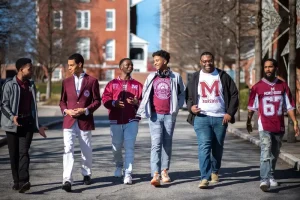
Photo from Morehouse College.
Choosing a university involves choosing a community. The 83% connection rate among HBCU students proves that when an institution prioritizes belonging, student success naturally follows. By selecting a campus that treats students as family, parents and students ensure a supportive journey toward a thriving future.
The unique power of the HBCU community turns the undergraduate experience into a transformative journey. By selecting an HBCU, students don’t just earn a degree. They gain a lifelong family, a network of passionate champions and an enduring legacy that will propel them forward for decades to come.
If you’re a parent concerned about your student finding community at college, or an incoming student wondering how to connect on campus, UNCF can help guide your journey to find the HBCU that’s right for you. Explore UNCF-member institutions, discover scholarship opportunities and read inspiring student stories on the UNCF blog. Follow UNCF on social media for updates on scholarships and member schools.
You can also support HBCU students by donating to UNCF to help expand access to educational opportunities for future generations.