Study Smarter, Not Harder: Productivity Tips That Actually Work

Key Takeaways
- Ditch the highlighter: Active recall outperforms passive rereading by forcing your brain to retrieve information.
- Space it out: Spaced repetition strengthens long-term memory and eliminates the need for stressful cramming.
- Manage your focus: Time boxing with methods like the Pomodoro technique keeps your energy high and prevents burnout.
- Silence the noise: Digital distractions fragment attention and increase cognitive load, making phone-free zones essential.
As midterms approach, the coffee starts flowing and textbooks pile up across every available surface. Many students assume academic success requires marathon study sessions, late-night cramming and endless highlighting. In reality, spending more time with your books does not always lead to better results.
The most effective students focus on studying smarter, not longer. Research shows that students retain information more effectively when they use evidence-based study techniques such as retrieval practice and spaced learning rather than relying on passive review or last-minute cramming.
By adopting proven study techniques, you can retain more information, perform better on exams and avoid the exhaustion that often comes with last-minute cramming. The following practices can help you boost your grades while still making time for friends, activities and much-needed rest.
Focus on Active Recall
 Reading the same chapter multiple times may feel productive, but familiarity is not the same as learning. Educational psychologists call this familiarity bias, and research shows that passive strategies such as rereading and highlighting are less effective than active study techniques.
Instead, use active recall. Close your book and challenge yourself to retrieve information from memory through flashcards, practice questions or verbal summaries. According to Harvard University’s Derek Bok Center for Teaching and Learning, active learning strategies improve student performance and exam outcomes. The effort required to recall information strengthens memory, helping you retain knowledge longer and retrieve it more easily on test day.
Harness the Spaced Repetition Effect
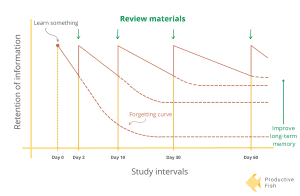
Graphic from Wikimedia Commons.
Cramming may help you remember information long enough to survive a test, but much of that knowledge quickly fades. Psychologist Hermann Ebbinghaus’ forgetting curve shows that people forget new information rapidly unless they revisit it over time.
That’s where spaced repetition comes in. Instead of studying a topic once, review it at increasing intervals over several days or weeks. According to researchers at the Harvard Graduate School of Education, this approach strengthens long-term memory by reinforcing information just as it begins to fade. Whether you use flashcards, practice quizzes or a study app, spacing out your review sessions can help you remember more with less last-minute stress.
Master Time Management With Time Boxing
A four-hour study marathon may sound productive, but focus tends to fade after 30 to 40 minutes. Instead of pushing through mental fatigue, try breaking your work into shorter, structured sessions.
The Pomodoro technique is a popular approach: study for 25 minutes, take a five-minute break and repeat. After four cycles, take a longer break. It helps maintain concentration, reduces burnout and makes large assignments feel more manageable by turning them into a series of achievable goals.
Control Your Digital Environment
 Multitasking may feel efficient, but research shows that constantly switching between studying and checking messages or social media reduces focus and productivity. The American Psychological Association notes that digital distractions can fragment attention, increase stress and hinder performance.
To stay focused, silence notifications, use website blockers or put your phone in another room. Creating a distraction-free environment helps you concentrate more deeply, making your study time more effective and efficient.
Pair Smart Study Habits With Strong Academic Support
As valuable as these study strategies are, students don’t have to navigate academic challenges alone. Historically Black colleges and universities (HBCUs) have a long history of providing personalized support, mentorship, tutoring and academic success programs that help students build effective study habits and time-management skills. Through scholarships, student support initiatives and advocacy, UNCF also helps remove barriers that can distract students from their education and academic goals.
Success in college is not about spending every waking hour studying. It’s about using your time intentionally and making the most of the resources available to you. By combining smart study techniques with support from UNCF, students can improve their academic performance, reduce stress and make the most of their college experience.