Why UNCF Matters Now More Than Ever

Key Takeaways
- HBCUs generate $16.5 billion in annual economic impact and support more than 136,000 jobs nationwide.
- Graduates from HBCUs continue to drive economic mobility, with the 2021 graduating class projected to earn $146 billion in lifetime earnings.
- Applications to public HBCUs have increased 126% since 2004, demonstrating growing demand for these institutions.
- UNCF remains committed to nonpartisan advocacy that expands educational opportunity and strengthens HBCUs.
- Federal and state investments in HBCUs help create pathways to college access, workforce readiness and economic growth.
Despite shifts in political leadership, some things never change. Throughout American history, changes in administrations and public policy have not altered this fundamental reality: our nation depends on educated people from every background to drive innovation, strengthen communities and fuel economic growth.
That reality makes the work of UNCF as relevant today as ever. As a nonpartisan advocate for historically Black colleges and universities (HBCUs), first-generation students, low-income students and educational opportunity, UNCF continues to champion policies that help more Americans access and complete a quality education.
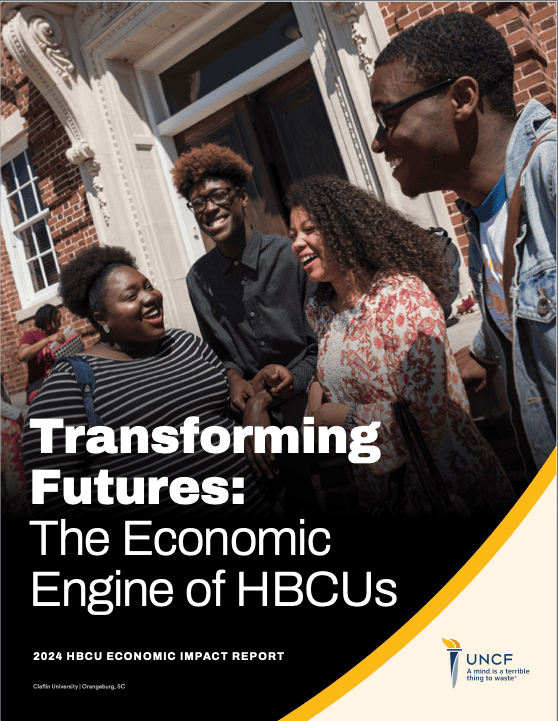
The need remains clear. According to UNCF’s 2024 HBCU economic impact report, HBCUs generate $16.5 billion in annual economic impact, support more than 136,000 jobs nationwide and create significant opportunities for social and economic mobility. The report also found that the HBCU Class of 2021 will generate an estimated $146 billion in lifetime earnings over the course of graduates’ careers.
Demand for HBCUs continues to grow. A recent analysis found that applications to public HBCUs increased 126% between 2004 and 2023, reflecting rising interest among students seeking the academic excellence, support systems and community these institutions provide.
A Legacy of Advocacy and Results
UNCF has long been on the front lines of efforts to improve educational outcomes for students and strengthen HBCUs. Through research, public policy advocacy and strategic partnerships, the organization works with lawmakers from both political parties, federal agencies and higher education leaders to ensure that decision-makers understand the challenges and opportunities facing HBCU students and institutions.
A key part of that work involves providing policymakers with data and real-world insights about college affordability, student success and the critical role HBCUs play in expanding educational and economic opportunity. By elevating the experiences of students, educators and campus leaders, UNCF helps shape conversations about higher education policy at the federal, state and local levels.
Over the years, that advocacy has helped secure important investments in HBCUs, including support for campus infrastructure and capital financing programs, federal student aid initiatives and programs designed to strengthen institutional capacity. UNCF has also championed policies that help reduce financial barriers to higher education, recognizing that cost remains one of the most significant obstacles many students face when pursuing a college degree.
Today, UNCF’s policy priorities focus on increasing college readiness, expanding access to affordable higher education and improving student success. The organization advocates for simplified financial aid, stronger student support services and clearer pathways from college to career, helping students gain the resources they need to graduate and succeed in a competitive workforce.
As workforce demands evolve and the economy becomes more skills-driven, UNCF also advocates for policies that help students develop the knowledge, credentials and career-readiness skills employers seek. By supporting both students and institutions, the organization works to ensure that HBCUs remain powerful engines of opportunity, economic mobility and community impact for generations to come.
Looking Ahead
 As discussions continue about higher education funding, workforce development and economic competitiveness, HBCUs remain a critical national asset. They continue to produce graduates who contribute to local communities, regional economies and the nation’s workforce while creating pathways to opportunity for students who have historically faced barriers to higher education.
UNCF’s mission remains rooted in the belief that educational opportunity benefits everyone. Regardless of the political climate, expanding access to quality education, supporting HBCUs and helping students achieve their full potential remain goals that strengthen the country as a whole.
As UNCF President and CEO Dr. Michael L. Lomax has noted, HBCUs continue to do more with less while serving as powerful engines of economic growth and social mobility. The data confirms what generations of students, families and educators have long understood: investing in educational opportunity is an investment in America’s future.