
IMPACT
UNCF Report Highlights HBCUs’ Role in Strengthening the Black Teacher Pipeline
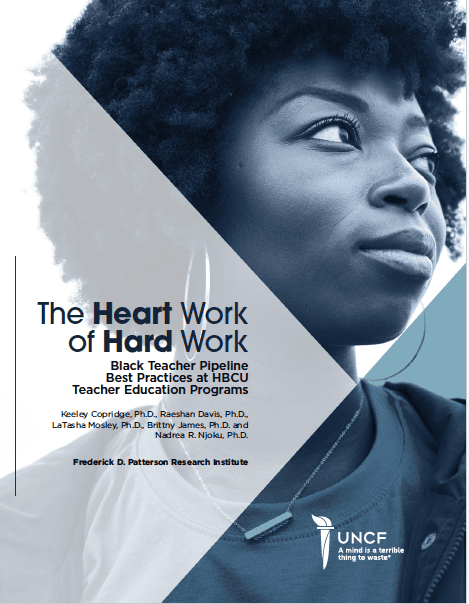
This UNCF report provides a snapshot of best practices from four HBCUs to strengthen the Black teacher pipeline. The research underscores the significant impact Black teachers have on Black students, including serving as role models, enhancing educational experiences, boosting graduation and college enrollment rates and improving reading and mathematics proficiency and end-of-year performance.
The report, The Heart Work of Hard Work: Black Teacher Pipeline Best Practices at HBCU Teacher Education Programs, features a snapshot of recruitment, culturally responsive teaching, curricular and co-curricular strategies that strengthen the Black teacher pipeline from four HBCUs: UNCF-member Huston-Tillotson University, Alabama A&M University, Albany State University and Fayetteville State University. The report, made possible by a donation from the Voya Financial Foundation, was authored by Dr. Nadrea Njoku, former assistant vice president, Frederick D. Patterson Research Institute (FDPRI), UNCF; Dr. Keeley Copridge, senior research associate, FDPRI, UNCF; Dr. LaTasha Mosley, graduate research fellow, FDPRI, UNCF; Dr. Raeshan Davis, a former research fellow, FDPRI, UNCF; and Dr. Brittny James, consultant, Insight Consulting and Associates. The four HBCUs highlighted in the report rank among the top 25 four-year HBCUs producing Black teacher graduates across various K-12 fields.
The research underscores the significant impact Black teachers have on Black students including serving as role models, enhancing educational experiences, boosting graduation and college enrollment rates and improving reading and mathematics proficiency and end-of-year performance.
Findings from the report were shared Feb. 13, 2024, as part of the “Equity in Education: Advancing Opportunities for Black Teachers and Parents” virtual learning series conducted by FDPRI. More information is available at UNCF.org/EquityinEd.
While HBCUs represent only 3% of colleges and universities nationwide, they produce 11% of all Black graduates and 50% of all Black educators, according to data from the FDPRI and the National Association for Equal Opportunity in Higher Education.
“Black teachers are essential to Black students’ educational, social and emotional development,” said Copridge, one of the report’s authors. “Yet Black teachers represent only 7% of America’s teaching workforce. To diversify the nation’s P-12 system, it is critical to strengthen the Black teacher pipeline and HBCUs are central to that effort.”
The report identifies historical and systemic barriers contributing to the scarcity of Black teachers, including desegregation, racism and standardized testing policies that resulted in nearly 100,000 minority teachers in 35 states losing their licenses from the late 1970s through the early 1990s.
“Black teachers are intimately aware of these barriers, but they continue to maintain high expectations for their students’ success,” said Njoku, another report author. “Research shows Black teachers have a deep understanding of Black students’ lives in and outside the classroom.”
Historically Black colleges and universities (HBCUs) are instrumental in the proliferation of Black graduates. HBCUs make up only three percent of colleges and universities, yet produce 50% of Black teachers (UNCF, National Association for Equal Opportunity in Higher Education, 2008).
The report calls for continued research on culturally responsive curriculum, examination of teacher certification exams, increased federal and state funding, partnerships with private organizations, expanded resources for HBCU faculty and the promotion of nontraditional pathways into teaching.
By issuing this report, UNCF demonstrates how strategic investment in HBCUs strengthens the nation’s public education system and ensures a new generation of Black educators is prepared to lead. Donor support enables HBCUs to implement innovative practices, overcome systemic barriers and cultivate teachers who inspire, mentor and transform the lives of students across the country. Through these efforts, UNCF and its partners are creating better futures for all Americans—because when HBCUs thrive, the nation’s classrooms thrive.